A Lost Garden Reborn
By Christopher S. Gerlach
An
Artist’s Visit to
Claude Monet’s Garden
at Giverny in 1981, told from 1998
Paintings are, for me,
the wink of an eye, a single seeing; a place, light, sunset,
flow of water, the glint on a seagull's wing far below a
windswept cliff. These moments, of seeing, I learned
from life and my own vision, and also from certain masters
that my artist's heart was drawn to, like a magic magnet;
and Claude Monet, the burly, surly, wild, wonderful painter's
painter, who launched into his art almost a century and
a half ago, and lingered in a forgotten twilight into our
own, he was such a mentor, a fellow seeker, to me.
There is a rough generous yet tender way his colors, his
light spilling paintings light a rainbow for me every time.
I held on to this attachment all the way through my art
schooling, when modern was ABSTRACT, and nobody painted
"things" or reality anymore. "You are
so out of it, Chris," some of the other students, teachers,
and later the critics, said. I didn't pay much attention,
but then I wasn't paying much attention to anyone.
Just sort of cruising on, eyes half focused, and generally
rather remote, but it worked for me. Finally complete
with the training and study I had set myself, I made a beeline
back to the USA, where people drove on the wrong side of
the street, and I started doing this work that some call
being an artist; for me it meant making paintings, living
in a little village on the beach outside San Francisco,
and finding some sort of way to keep hidden from the outside
world in my own creations of light and paint.
I had returned
from three years of wonderful study in England, at the remarkable
Ruskin School of Drawing at Oxford, to begin my own work
as a landscape painter in the last days of 1979. America
at that time was still empty of realism in contemporary
art, and I worked in my little corner of things, following
my own vision more stubbornly than inspired. By chance,
the small oceanside village I settled in just north of San
Francisco was also home to a benefactor of Versailles and
a friend of the Gerald Van Der Kemps; Gerald was the former
Director of Versailles. My friend bought a painting
of mine in my first show stateside, and suggested the possibility
of my visiting Giverny.
In this
time, after I had my first show, and my first pan by the
critics, they called me a neo-post impressionist, I had
a really heaven sent chance to visit the final hideout of
the greatest impressionist of them all, Monet.
It was like being in
a double exposure, a picture of a picture, a movie of a
movie, for the paintings were so familiar to me, and the
stories of this man and his place... and yet seeing is much
more than believing; it is living alongside, and within
life. I think I had a hint then this was what art
was for me, or would be: the real thing.
What I remember most
clearly at first was seeing the water lily pool, in the
early morning light; veils of mist rising into the light
and birds singing everywhere. The water held the reflections
of the sunlit trees, for the summer sun had just risen.
It was cool, and smelling the air was like drinking perfume;
hyacinth, wisteria, rose, lavender drifted on the air.
I was a painter, in a painter’s garden, and the colors
and the shapes made sense to some hidden part of me that
always sings with color and light. I had come there
to paint, in the garden of one of the greatest recent painters.
The garden had been reborn after a sleep of over fifty years.
And I am reborn, thinking back to this time, now almost
twenty years ago for me. Awakenings and re-awakenings mingle
with memories and a present sense of joy and hope and life.
Claude Monet
lived a determined and at times stormy life. He was
consumed by his work, his passion for light and color.
All his life, he pursued effects of sunrise, of full day,
storms and sunsets; and dragging his brush through a jungle
of color he placed each scene, each moment into pictures
that are filled still with his passion and the light of
life. A single figure in the snow, sun drenched light on
the falling rising face of a great cathedral, green glinting
groves, dapple wrapped summer rivers, boating, floating,
sailing, all kinds of scenes, and he gave them all the rough,
untamed vitality, the bravura, the vim, the incunabula like
glow of art freed finally from the old cold frame. True,
he had an edge, for the old world of wood, and cloth and
canvas, of undeveloped countryside, and still new towns
and cities had still not fallen into "modern"
sameness and a sort of hostile reign over our lives.
And modern media, photographs, and other ways had not robbed
art of the magical role of master impresario, bridegroom
of beauty, and the window of appreciation. Success
came after long years of work, and with the success, he
bought a home that was an old farmhouse in the little town
of Giverny, about two hours by fast train from Paris to
the west. He lived at this house all the last part
of his life, and found another passion to add and weave
into his art, the art of gardening.
The house lay
near the slope of a low range of hills north of the Seine
River, and across the river meadows in his time, you could
still see the river in the distance. The house was
long, painted a traditional pink which he kept, two storied
and stood on enough land to plant and flourish as Monet’s
garden. He planted avenues, a central avenue or row
of arbors and beds of flowers that led from the house down
to a series of pools that he planted with water lilies.
All around this central feature were other beds and paths,
each filled with particular flowers in different seasons.
Amid all this were fruit trees, and flowering trees, and
around all wrapped the moist sunlit air of the river valley
and France.
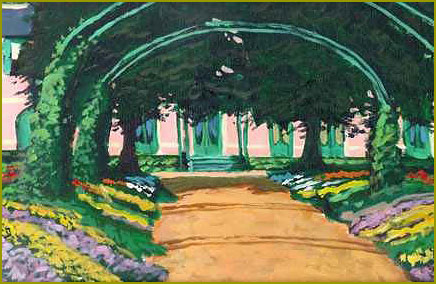
The
Front Walk – Monet’s House: Giverny
Oil on Canvas 1980
For all the years
that he lived at Giverny, Monet kept adding to the garden.
He was remarried at the time, and Blanche, his second wife
brought to his life her children and a household of servants.
This retreat became Monet’s world; and from it he drew
inspiration for a number of series of incredible paintings;
mosaics, tapestries, symphonies in color and movement and
paint. Among these late paintings were innumerable
ones of the water lilies floating in the sky reflected in
the water of the pools, in all lights and all times of day.
Over time, he
became so wrapped up in the water lily theme he conceived
of a great work, perhaps his greatest work; a long figure
eight surround, eight feet high and hundreds of feet long
that eventually was hung in a special museum in Paris, the
Orangerie, through the efforts of his good friend, Georges
Clemmencau, the Prime Minister of France not too long after
the turn of the century. This immense work took many
years, and was and still is a masterpiece of floating space,
brilliant and at the same time pearly and magical mystery
of color and light through color. One of the amazing
things about this project, which was carried out with the
help of huge easels, and new specially designed studio and
many helpers, was that during this he began to go blind.
For the blindness, from cataracts, at that time, doctors
prescribed opium, and he grew opium poppies in his garden.
The effect of this potion made his color even more advanced
and strong, and he kept working, having to stand almost
right against the canvas to see at all.
After his death
in 1926, the house was neglected. All the family moved
away, and the house stood, with the furniture and art within
untouched, for forty years. One gardener who remained
living in the village would trim the central allé
once a year and keep it clear, but over time, the garden
fell into disrepair and abandonment. Art and taste
had moved on as well, and Monet was regarded for many years
as a fossil, and a lost and forgotten form of art, unwanted
in the tide of abstraction and personal explosion that was
much of Modern Art.
By chance and
Destiny, Gerald Van Der Kemp, who had for many years been
the curator of the vast palace of Versailles and his wife
Florence visited the garden. They were enchanted by
the magic and mystery of the place. A brief flurry
of attention had occurred previously, in 1959, when Monet’s
last son died in a car accident and the house had been visited
by lawyers doing the Will and settling affairs. They
found over 700 paintings in the studios at Giverny, unknown,
and abandoned; and this tide of brilliant paintings began
to reach the world through the auctions at Christie's and
Sotheby’s and into the collections of museums and collectors
across the world. So in a way, Monet came to life
again, gradually and over time.
When Gerald and
Florence found the garden, he had just retired from his
Director’s post of Versailles. On an inspiration,
they invited Lily Atchison Wallace, who with her husband
had been the founders of Reader’s Digest to lunch in
New York, and over lunch, she gave them a check for a very
generous amount to begin the restoration of the gardens
at Giverny. It took many years, for by then all traces
of the plantings, and much of the garden structure and the
house were almost totally in ruins. Furniture in the
house was rotting, paintings by masters such as Degas and
Pissaro, Monet’s friends and fellow artists, had mushrooms
growing out of them, hanging on mold streaked walls.
The restoration
and research was finally completed in the late 1970’s
and the actual work of rebuilding and replanting begun.
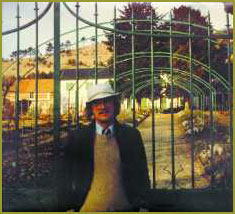
Gerlach at Giverny 1979
I had visited the area
on a pilgrimage of sorts from Paris in 1979, and saw then
the structure of the arbors, and actually walked around
the pools, and saw the outside of the house from the road;
but there were no plants then, it was winter, and all was
bare. I had no idea that another stroke of destiny
would bring me back to paint there myself three years later.
The visit was a mix between a dream
and a dance to music I felt deep in my heart. I am,
I suppose, many things as well as an artist; my paintings
were for a long time the only way I had of saying my being.
To reach this place of my painting and vision, I had to
go back 100 years to the days of the Impressionists; for
the way they saw is the way I see; and the colors and light
that they pursued, I still love and paint. Monet was
probably the primary influence on me, and to be there, in
his garden, many years later, in 1980, as this story started
out, was deep for me, and a very special time. I got
off the train, and actually walked to the village where
the house and garden were. It was spring, France,
greenest of green growing places, was sunshine, and pale
blue sky, filled with dancing clouds, and the flowers, flowers
everywhere; every time I go to France, I remember first
and last, the flowers.
I stayed in a
small aubnerge or inn in the village, which was really just
a collection of houses, an few shops and the main road from
to Paris. You can whisk by on the fast train, along
the railroad down by the river, and Giverny would be gone
in a instant. I spent ten days there, and painted
in the gardens in all lights and all times of day; wrapped
in the past, the present and leaning then, I see now, into
this future moment which is now here, where my own art has
grown and opened with me; like one of the beautiful flowers
of the water lilies; one moment a bud, then a blossom hanging
between air and water and filled with light and incredible
color. As I was traveling rough in those days, I could
take only small canvases with me; and easel and paints and
a few clothes. When I got back to San Francisco, I
began unwinding and weaving the memories, and pictures and
paintings began to be. Soon the little redwood house perched
amid the eucalyptus groves above the bay in Sausalito was
filled with the light and colors of Monet’s Giverny.
One painting after another came, almost demanding life,
form and to be.
I worked all that time I was at Giverny with a sense
of connection and unity with Monet; at times I felt that
I could see him, bulky figure with old tweeds, a battered
hat, huge white beard and a smelly pipe peering out from
behind the arbors, half hidden in the dusk or in early dawn.
My easel was often right at the water’s edge of the
pool, early so as to not disturb the visitors of the day,
and to also catch the fleeting and magical early tints of
light that cascaded through the willow trees above the water’s
face. As I worked, the sounds of the garden, the birds,
even my own breathing slipped away, and I was one with my
brush, the next color, the next stroke, until the painting
was, in it’s own time, done. The arbors of the
garden lined a central avenue, which ended in the lily pool
at the bottom of the gentle hill slope, beyond through gates
were water meadows, willows, and finally the long, gleaming,
glistening every flowing dancing river, the Seine, on her
way to the sea. Water seemed everywhere, even in the
air, for wonderful mists rose in the dawn, and fell again
at dusk. All edges were softened, you walked softly,
spoke softly, lived gently, and will a flowing sense of
joyful drowsiness; not needing to hurry, just enjoy.
The garden beds were kept filled by Monsieur Vallier, a
veteran master gardener, and evidently, in Monet's time,
the same parade of colors, reds, yellows, oranges, gleaming
purple iris, cascades of brilliantine alabaster wisteria,
honeysuckle, filled the garden with living versions of the
piles of pigment on Monet's palette. In such a living
painting, I began to paint, feeling almost like I was trying
my own wings, new fledged, in a sky that an eagle had flown;
feeling safe to try, for his works were all with us to see.
You see, Monet painted with a mastery born of deep knowing,
tremendous experience; and these had led to his own kind
of freedom, looseness; knowing just how to hint, and suggest,
and deftly tenderly coax belief from our eyes, with not
a single extra or unneeded stroke or word.
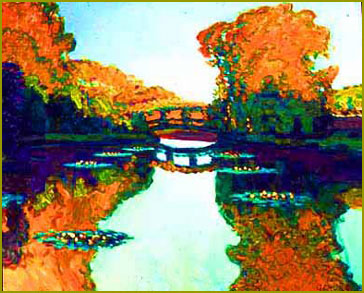
The
Waterlily Garden – Late Afternoon
Oil on Canvas 1980
It was this subtlety
that it was to take so long, in so many different lessons,
for me to even see the need for. But there, wrapped
in the amber light, the flowing shades of light and shadow,
and above all the glory and secret paradise of the waterlily
pond, the water garden, I felt wrapped in this knowing with
no effort.
I remember the colors of
the house, pink and green on the outside, and inside, the
light filled yellow dinning room with the matching purple
and yellow china. The house was a reflection of the
colors from the garden, and fresh flowers daily placed around
seemed to bring the garden in with them. The mixture
and flow of life, home, work, art and the beauty of the
garden and the countryside wove a pattern that still comes
as I write these words. Art released from museums,
and frames and limits maybe can be part of all we are and
do, artful living, gentle touch, mindful, and grateful caring.
The stories of Monet, his life there
and memories of those times were all around the village;
I got to know Monet’s grandson, who still lived in
the village, and remember a special evening having dinner
with him and his partner, and a walk home to my inn with
them, in the moonlight down lanes filled with the night
scent of honeysuckle and jasmine and the sound, which I
had never heard before, of nightingales singing from the
woods as we passed along. I began to understand
then, that time and the most wonderful blessings of peace
and beauty wait for us, unseen, along our path, and when
we can see them, they appear. The memory of this moonlight
walk, that moment, now many many years ago, it is here,
as I write. As this lei of wonders and understandings
started to grow, I can finger it, and say, yes, this one,
this was that walk; the feel of the rough French road, the
wet smell of the sleeping woodlands, the fall, like golden
jewels of living sound, of the limpid, liquid, magical song
of those nightingales, and over all the slender new moon
and the soft glowing stars.
Time seemed to
be quite meaningless there in that place, with the beautifully
recreated gardens all around. At the time the establishment
was quite new; since, I have heard that many thousands,
maybe more, visit there each year during the season.
The flowers and gardens grow more lovely, full, and deep
in every art photograph book, calendar and print I see of
Giverny in bookstores and malls and friends’ homes.
I wonder sometimes what my own art would be now if I hadn’t
gone and been there for that time. Sometimes I wonder
if some sort of passage of energy and life force was waiting
for me there, on the Japanese bridges under the wisteria,
along the alleys of flowering blossoms, waiting to enter
and merge with my vision, and being. I do not know,
but when I close my eyes, I can still see the pools, wrapped
in lavender and light, just a footstep away from Monet and
his vision, a vision of the garden of Eden here today, and
of the garden of delight in each of us. I will always
be grateful to the Van der Kemps, to Mrs. Wallace, and to
my friend for this visit to what may have been a missing
part of myself, waiting to come home.
I remember especially
stretching three large canvases, eight feel tall, without
knowing what they were to be. In one morning, the
water lily pool appeared, flowers and lily pads floating
in an azure heaven, my vision to be sure, but also shared
with the man who had pursued these fragile beauties in his
own garden an ocean and half a century away.
Another series of mine was the water garden, as it appeared
at dawn, and on through the day. Each picture a window
in time and timelessness. I have looked back to this
time as one of effortless joy, and a flow beyond and within
me and my art; a touchstone for times of questioning now
and to come. Each moment of our lives is informed,
created by all our past, and flows seamlessly into our unknown
future... moving, flowing, slipping away and past, never
to return. Yet, each of my paintings holds a hint for me,
not only of how I see and paint is changing and growing,
but also how life was then, at that single moment. And perhaps,
in time, these windows may, perhaps indeed will invite others
to see what I see, feel what was “that” single
instant, fleeting, unique, that made up and makes up each
precious day... a gift, as Monet so surely knew, there always
for us all.
About
the Author and Artist
Christopher currently lives and works in Southwestern Colorado, in the town of Pagosa Springs
but is planning to return to live in Santa Barbara, where he grew up and which has always remained the home he has been away from. He was one of the first modern
artists to revive realism in paintings, and continues to work in this genre combining both plein air and studio work in his own unique blend of painterly style and
bright palette. He writes, paints and works to aid Ecology and other interests. He is also the Publisher of a small press dedicated to creating beautiful and insightful
works on social health and in aid of environmental causes.
He loves life, in all it’s surprising forms, and believes that we can, each of us, make a difference.
All Text and Images are Copyrighted
Copyright © Christopher Gerlach 2004-2007
These paintings and others from Chris' collection are available
through the artist.
Slides, Terms, and Prices Available upon request
Current
Gallery Representation and Vitae
Commissions
and Special Projects Welcome
GALLERIES: New Works | California | Colorado | France | Giverny | Great Britain | Oxford | Italy
Portugal | Rocky Mountains | San Diego | Santa Barbara | Southwest | Venice | Public
Installations
Printable Vitae 2008 (PDF) | Bio | Contact
All
Text and Images Copyright © 2004-2012 Christopher Gerlach
Original Copyright on All Images Retained by the Artist
